
India Golden Triangle in 7 Days
This route takes you through three cities that are constantly changing: in the morning among mausoleums of red sandstone, at midday in the crowd of old bazaars, in the evening with a wide view over forts and gardens. In Delhi everything begins with sultanate architecture, Mughal tombs and broad ceremonial axes, before Agra takes over with its riverside gardens and monumental complexes. Jaipur finally sets warm colors, observatories, palaces and forts onto the hills.
What is special about this week is the clear dramaturgy: first Delhi's many layers, then the great Mughal stage in Agra, after that the striking Rajasthan feeling in Jaipur. You see world-famous icons but also quiet places that pleasantly loosen the rhythm of the trip.
Who is this trip for?
This trip is ideal for you if you want to see a lot in a short time and find culture, architecture and city atmosphere more important than long breaks. It suits first-time visitors to India who want to experience the Golden Triangle compactly but not rushed.
What to expect
Expect a dense mix of city walks, major sights and, again and again, wide complexes where you can briefly catch your breath. The days have a brisk pace, with many shifts of perspective between gardens, mosques, forts and lively streets.
Day 1 · Delhi, India
Delhi between dynasties
The start in Delhi is monumental right away: at the Qutb Minar you see how high and bold the early sultanate buildings were conceived. Then Lodhi Garden feels almost like a pause in the city's pulse, with domed tombs among old trees and broad paths. Later, Humayun’s Tomb takes you right into the formal elegance of Mughal architecture, which already sets the grand line here.
- Qutb Minar
- Lodhi Garden
- Agrasen ki Baoli
- India Gate
- Humayun’s Tomb
 © Muhammad Mahdi Karim · GFDL 1.2
 © Amaninder · CC BY-SA 3.0
 © Slyronit · CC BY-SA 4.0
 © Quintin Soloviev · CC BY 4.0
 © Muhammad Mahdi Karim · GFDL 1.2
Day 2 · Delhi, India
Old Delhi and remembrance
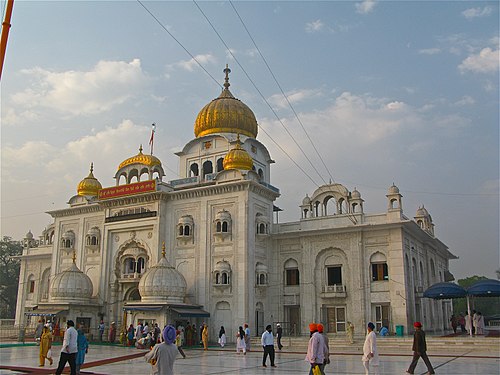
The day begins calmly at the Gurdwara Bangla Sahib, where water surfaces and prayer show a very different side of the city. Then the mood tips immediately into the dense and moving at Chandni Chowk: narrow alleys, voices, traffic and constantly new impressions. With the Jama Masjid and the Red Fort this becomes a day that makes Delhi's political and religious history very tangible.
- Gurdwara Bangla Sahib
- Chandni Chowk
- Jama Masjid
- Red Fort
- Raj Ghat
 © Ken Wieland from Philadelphia, USA · CC BY-SA 2.0
 © Bikashrd · CC BY-SA 4.0
 © PerSona77 · CC BY-SA 3.0
Day 3 · Agra
Agra with an imperial view
With Fatehpur Sikri, Agra starts outside the city limits on a grand stage: wide courtyards, red walls and the feeling of a planned center of power. The Tomb of Akbar then brings in a quieter, almost contemplative note. In the Agra Fort everything condenses once more at the end into a massive complex where politics, defense and courtly life lie closely together.
- Fatehpur Sikri
- Tomb of Akbar
- Shahi Jama Masjid Agra
- Anguri Bagh
- Agra Fort
 © Marcin Białek · CC BY-SA 3.0
 © China Crisis · CC BY-SA 3.0
 © A.Savin · FAL
Day 4 · Agra
Gardens on the Yamuna
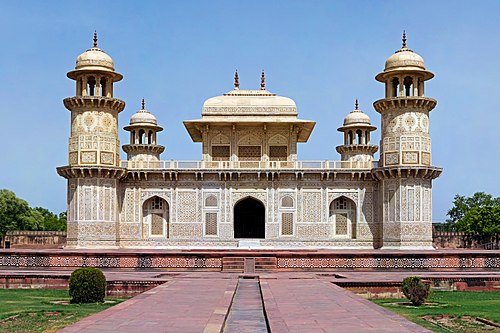
The fourth day shows Agra from its finer, almost poetic side. Itmad-ud-Daula, with its details and proportions, feels like a delicate prelude to what is still to come. When you later look across through Mehtab Bagh to the Taj Mahal and then stand right before it, you notice how strongly this place lives off axes, light and stillness.
- Chini Ka Rauza
- Itmad-ud-Daula
- Mehtab Bagh
- Taj Mahal
 © Rangan Datta Wiki · CC BY-SA 4.0
 © Muhammad Mahdi Karim · GFDL 1.2
 © g.kaustav · CC BY-SA 3.0
 © Yann; edited by Jim Carter · CC BY-SA 4.0
Day 5 · Jaipur
Jaipur in pink
Jaipur greets you photogenically at the Patrika Gate, where colors and patterns immediately set the tone. Then it turns more classic at the Albert Hall Museum, with a facade that works on its own and marks the transition into the historic city center. Between Jantar Mantar and Hawa Mahal the city shows its clear, striking side: scientifically precise and at the same time unmistakably decorative.
- Patrika Gate
- Albert Hall Museum
- Jantar Mantar
- Hawa Mahal
 © Ajit Kumar Majhi · CC BY-SA 4.0
 © Knowledge Seeker · Public domain
 © Chainwit. · CC BY-SA 4.0
Day 6 · Jaipur
Palaces and heights
At the Galta Ji Temple the day begins with steps, basins and a location that stands clearly apart from the city center. In The City Palace you then switch to the representative heart of Jaipur, where courtyards and facades make the city's royal order tangible. To close, Nahargarh fort Jaipur brings the wide view: the city below, the walls in front, the hills behind.
- Galta Ji Temple
- The City Palace
- Shri Radha Gopinath Ji Temple, Jaipur
- Nahargarh fort Jaipur
 © Jakub Hałun · CC BY-SA 4.0
 © Sanyam Bahga · CC BY-SA 3.0
Day 7 · Jaipur
Forts around Amber
With the Jal Mahal the day starts calm and almost unreal, as the palace lies in the water and the hills rise behind it. Then Jaigarh Fort takes the scene with massive walls and clear strategic presence. In the Amber Palace and at the Panna Meena ka Kund the trip ends with exactly the Rajasthan image that stays in your mind: fortress architecture, geometric forms and warm stone colors.
- Jal Mahal
- Jaigarh Fort
- Amber Palace
- Panna Meena ka Kund
 © A.Savin · FAL
 © Acred99 · CC BY-SA 3.0


Free – swap sights, rearrange days, add hotels & restaurants.