

USA Southwest in 14 Days
This route begins between neon, asphalt and desert, and then shifts day by day into larger landscapes. You first stand before the colors of Seven Magic Mountains, later at the rim of the Grand Canyon, drive through the expanse of Monument Valley and look into rock worlds in Bryce and Zion that appear different with every glance. In the end the trip lands in the quiet, hard openness of Death Valley.
What is special about this tour is the strong contrast between city and nature, viewpoint and trail, iconic photo stops and long scenic roads. You collect many of the Southwest's best-known images, but in an order that keeps feeling new along the way.
Who is this trip for?
This trip is ideal for anyone who wants to see a lot on a road trip and is up for big landscapes, short hikes and striking viewpoints. If you want to bring famous highlights not just into a checklist but into a coherent travel flow, this route suits you very well. The pace is active but not extremely sporty.
What to expect
Expect a varied mix of driving stretches, viewpoints right by the car and several short to medium trails. Some days start early for light, expanse or more pleasant temperatures, others leave room for relaxed looking and settling in. The rhythm stays lively: city, red rocks, canyons, desert and ever-new horizons.
Day 1 · Las Vegas
Neon and first desert colors
To open, you drive to the Seven Magic Mountains, where colorful stone blocks in the middle of the desert act like a deliberately set contrast. Then the classic at the Welcome to Fabulous Las Vegas Sign is simply part of it, before in the evening you experience the Fountains of Bellagio between light, water and city noise. So Las Vegas sets the tone on the very first day: loud, visual and surprisingly close to the open landscape.
- Seven Magic Mountains
- Welcome to Fabulous Las Vegas Sign
- Fountains of Bellagio
- Las Vegas Strip
- The Venetian Las Vegas
 © Thomas Wolf, www.foto-tw.de · CC BY-SA 3.0
 © Kashyap Hosdurga · CC BY 2.0
 © Marek Ślusarczyk (Tupungato) Photo portfolio · CC BY 3.0
Day 2 · Las Vegas
Red rocks and old neon
The day begins out in the Red Rock Canyon National Conservation Area, where the city suddenly seems far away and the rocks rise in warm layers. Later the Sphere feels like a glimpse into the future, before the Fremont Street Experience takes over with its dense, fast energy. To close, The Neon Museum Las Vegas brings the city's history back in the form of signs, colors and faded glamour.
- Red Rock Canyon National Conservation Area
- Sphere
- Fremont Street Experience
- The Mob Museum
- The Neon Museum Las Vegas
 © Y2kcrazyjoker4 · CC BY 4.0
 © Jean-Christophe BENOIST · CC BY 3.0
 © Wtstoffs · CC BY-SA 3.0
Day 3 · Grand Canyon Village
Grand Canyon from the southeast
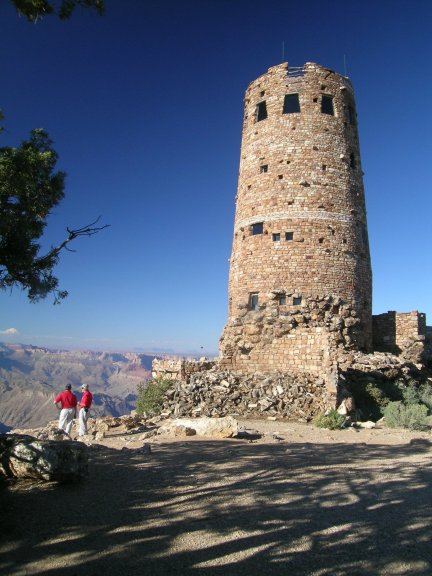
With the South Kaibab Trail you start straight into the dimensions of the Grand Canyon instead of just looking at it. Then Grandview Point opens the view wide over edges, steps and shadows that keep shifting. At the Desert View Watchtower the day ends with a viewpoint where architecture and landscape fit together especially well.
- South Kaibab Trail
- Grandview Point
- Tusayan Ruin
- Lipan Point
- Desert View Watchtower
 © Gonzo fan2007 · CC BY-SA 4.0
 © Deacon Steve from Northfield, U.S.A. · CC BY 2.0
 © Rossstatham at English Wikipedia · CC BY 2.5
Day 4 · Grand Canyon Village
Classic views on the south rim
Hopi Point shows the canyon in broad, clear lines, a good place to just stand and look at first. On the Bright Angel Trail you then quickly notice how the landscape changes with every step and the depth becomes tangible. To close, Mather Point awaits with one of the trip's best-known panoramas, and yet the view feels anything but routine.
- Hopi Point
- Bright Angel Trail
- Yavapai Viewpoint Road
- Grand Canyon Visitor Center
- Mather Point
 © Grand Canyon National Park · CC BY 2.0
Day 5 · Oljato-Monument Valley
Monument Valley for the first time
Already at Forrest Gump Point the road builds up before you like a film scene, with Monument Valley on the horizon. Then Artist's Point follows, one of those views where forms and distances feel almost unreal. At John Ford Point you are then right in the middle of the landscape that suddenly gains real scale out of the images.
- Forrest Gump Point
- Artist's Point
- North Window Overlook
- John Ford Point
- Monument Valley Tribal Park Visitor Center
Day 6 · Oljato-Monument Valley
Rocks, traces and expanse
In the Goulding's Museum you get a sense of how closely landscape, film history and everyday life are connected here. On the Wildcat Trail you then experience Monument Valley not just from the viewpoint but at eye level with sand, silence and the striking formations. From The View Hotel the scenery looks different once more: wider, quieter and made for a long gaze.
- Goulding's Museum
- Wildcat Trail
- The View Hotel
- Ear of the Wind
- Totem pole
 © Bernard Gagnon · CC BY-SA 3.0
 © Luca Galuzzi (Lucag) · CC BY-SA 2.5
Day 7 · Page
To Page by the lake
The Toadstool Hoodoos Trailhead leads you through a strangely playful rock landscape that looks almost modeled. Then the expanse of water, sand and sky opens up at the Lone Rock Beach Campground, a completely different rhythm than the days before. From the Wahweap Overlook you finally see how large and branched this area really is.
- Toadstool Hoodoos Trailhead
- Lone Rock Beach Campground
- Wahweap Overlook
- Carl Hayden Visitor Center
- Glen Canyon Dam Overlook
Day 8 · Page
Gorges and bend views
In Waterhole Canyon the rock walls move close together, the light falls in stripes and every section looks different. Then Horseshoe Bend awaits, one of the Southwest's most famous river bends, which looks almost too perfect from up high. With Antelope Canyon Navajo Tours the day ends in a slot-canyon world of lines, shadows and warm stone.
- Waterhole Canyon
- Horseshoe Bend
- Page
- Navajo Village Heritage Center
- Antelope Canyon Navajo Tours
 © Thomas Wolf, www.foto-tw.de · CC BY-SA 3.0
Day 9 · Bryce Canyon City
Bryce in morning and evening light
At the Red Canyon Visitor Center the colors already announce where the day is heading: into a landscape of red, orange and pink. From Bryce Canyon National Park Sunrise Point you look at an amphitheater of hoodoos that looks especially three-dimensional in the slanted light. Between Bryce Canyon National Park Sunset Point and the Navajo Loop Trail you then get closer to the formations step by step.
- Red Canyon Visitor Center
- Bryce Canyon National Park Sunrise Point
- Bryce Canyon National Park Sunset Point
- Navajo Loop Trail
- Upper Inspiration Point
 © Sara Simoni · CC BY-SA 3.0© Sara Simoni · CC BY-SA 3.0
Day 10 · Bryce Canyon City
More Bryce, more forms
In the Kodachrome Basin State Park the day begins with quieter rock forms and a wide sky, before it goes back into the Bryce Canyon National Park. Bryce Point shows the landscape in all its density, almost like a stone sea of towers and spikes. At Fairyland Point the whole thing looks even wilder and a bit more removed.
- Kodachrome Basin State Park
- Bryce Canyon National Park
- Bryce Point
- Fairyland Point
- Mossy Cave Trailhead
Day 11 · Springdale
Arriving in Zion
The Zion National Park receives you with steep walls, green on the valley floor and a completely different narrowness than Bryce. On the Riverside Walk you follow the river deep into the canyon, right up close to water, rock and shade. The Zion Canyon Scenic Drive connects these impressions into a day that relies less on distant views and more on immediate grandeur.
- Zion National Park
- Riverside Walk
- Angels Landing Trail
- Emerald Pools Trailhead
- Zion Canyon Scenic Drive
Day 12 · Springdale
Views over Zion's valley
The Canyon Overlook Trail delivers a strong panorama over the incised landscape with little distance. In the Zion Human History Museum the place then gets a calm, contextualizing frame, before the Watchman Trail opens up views of valley, rock walls and river once more. So Zion shows both overview and closeness in a single day.
- Canyon Overlook Trail
- Zion Human History Museum
- Watchman Trail
- Pa'rus Trail Zion National Park
- Zion Outfitter
Day 13 · Death Valley Junction
Switch to Death Valley
The Alabama Hills National Scenic Area first provides a rugged, film-worthy intermediate stage with rock arches, blocks and open surfaces. Then Ubehebe Crater feels like an abrupt cut into the landscape, rough and almost black at the edge. In the Mesquite Flat Sand Dunes the line of the desert finally takes over again, softer in form but just as impressive.
- Alabama Hills National Scenic Area
- Ubehebe Crater
- Mesquite Flat Sand Dunes
- Death Valley National Park
- Furnace Creek Visitor Center
 © Jim Gordon · CC BY 2.0
 © Tobias1983 · CC BY-SA 3.0
Day 14 · Death Valley Junction
Salt, color and wide views
From Dantes View you look far out over the basin of Death Valley, and the dimensions become tangible at a glance. Down in Badwater Basin you walk out onto the bright salt flat, where space and heat change the perspective. With Artists Palette and Zabriskie Point the trip ends between pastel colors, erosion forms and a last great view over this extreme landscape.
- Dantes View
- Badwater Basin
- Artists Palette
- Zabriskie Point
- Golden Canyon Trailhead
 © Roger469 · Public domain


Free – swap sights, rearrange days, add hotels & restaurants.